Brain
7 min read · Published July 22, 2026
Smoking and the brain: stroke, shrinkage and dementia risk
Everyone knows nicotine acts on the brain. Fewer people know that smoking measurably changes the physical structure of brain tissue and how long it keeps working.
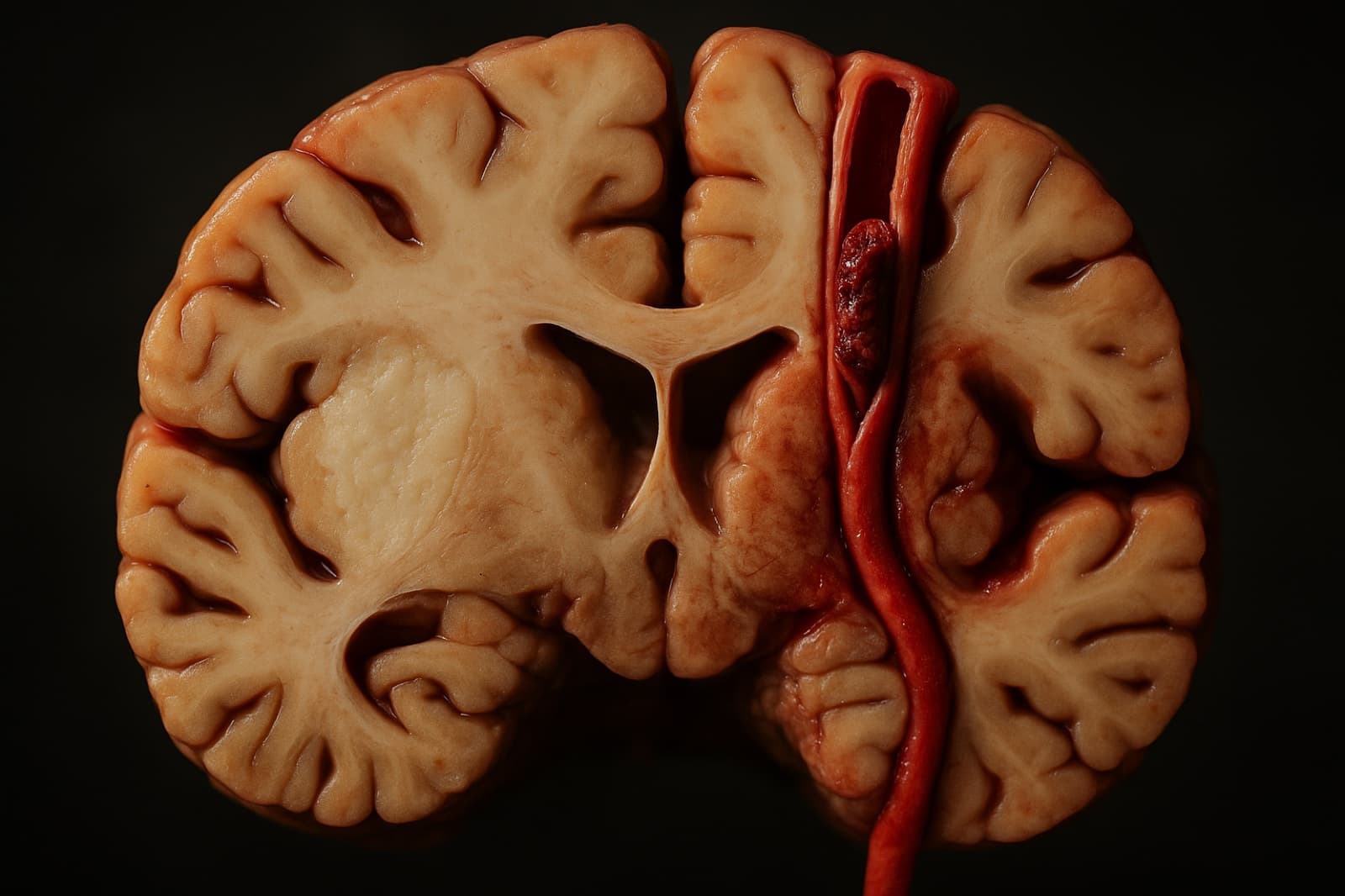
A stroke, from the inside
Smoking roughly doubles the risk of ischemic stroke. A stroke does not always kill: often it takes speech, the use of one side of the body, or the ability to live alone, for decades.
Medical illustration generated with AI. Not a photograph of a real patient.
Stroke: the fastest, most brutal outcome
Smoking roughly doubles the risk of ischemic stroke, through the same mechanism as heart attacks: damaged vessel walls plus blood that clots too easily.
It is also a major risk factor for subarachnoid haemorrhage, bleeding from a ruptured aneurysm, which frequently strikes people in their forties and fifties and kills or disables a large share of those affected.
A stroke does not always kill. Often it takes speech, the use of one side of the body, or the ability to live independently, for decades.
Physically thinner brain tissue
Neuroimaging studies have found that smokers show accelerated thinning of the cerebral cortex compared with never-smokers, in a dose-dependent way: more pack-years, more thinning.
Some recovery of cortical thickness appears after quitting, but it is partial and slow, which is an argument for quitting earlier rather than later.
Dementia
Large reviews consistently find that current smokers have a substantially higher risk of Alzheimer's disease and vascular dementia than never-smokers. The WHO estimates that a meaningful share of dementia cases worldwide are attributable to smoking.
The mechanisms overlap: chronic small-vessel damage, oxidative stress and inflammation. Former smokers show risk closer to never-smokers, which means the trajectory can change.
The everyday cognitive cost
Smokers perform worse on average in tests of memory, processing speed and executive function in midlife studies. Part of it is vascular; part is the cycle of mild withdrawal between cigarettes, which fragments attention all day.
Many people who quit report noticeably better concentration after the first month, once the brain finishes the withdrawal adjustment. The fog they blamed on age or stress was often chemistry.
The takeaway
The brain is the organ you cannot transplant and cannot replace. Quitting lowers stroke risk within years and moves your dementia risk curve toward that of people who never smoked.
Knowing the damage is step one. Step two is the counter.
Start your smoke-free clock now and watch these exact systems repair themselves, hour by hour.
Start my counterKeep reading
Educational content based on public health sources including the WHO, the CDC and U.S. Surgeon General reports. It does not replace medical advice: talk to your doctor about your specific case.